- The High Performance Playbook
- Posts
- The True Cost of Daily Interruptions
The True Cost of Daily Interruptions
The High Performance Playbook

Austin Wright
December 5th, 2025 • Est. Reading Time: 16 minutes
Welcome to Week 40 of the High Performance Playbook.
You’re now reading with 17,000+ other high performers! A huge thank you for reading and for continuing to share The High Performance Playbook with friends, family, and co-workers. Your support means the world.
If you’re new and just tuning in to the HPP, we cover the strategies and frameworks that separate the 1% from the .01%. We dive deep into: health & fitness + longevity, personal finance & investing, business growth hacks, and how to optimize all areas of your life.
If any of those topics sound interesting, the High Performance Playbook is for you.

If you enjoy the content and get some value from it, please share this link with a few friends and help me spread the word! There’s no better compliment than a referral.
Ready? Start your engines… Let’s GO:

Mindset & Psychology
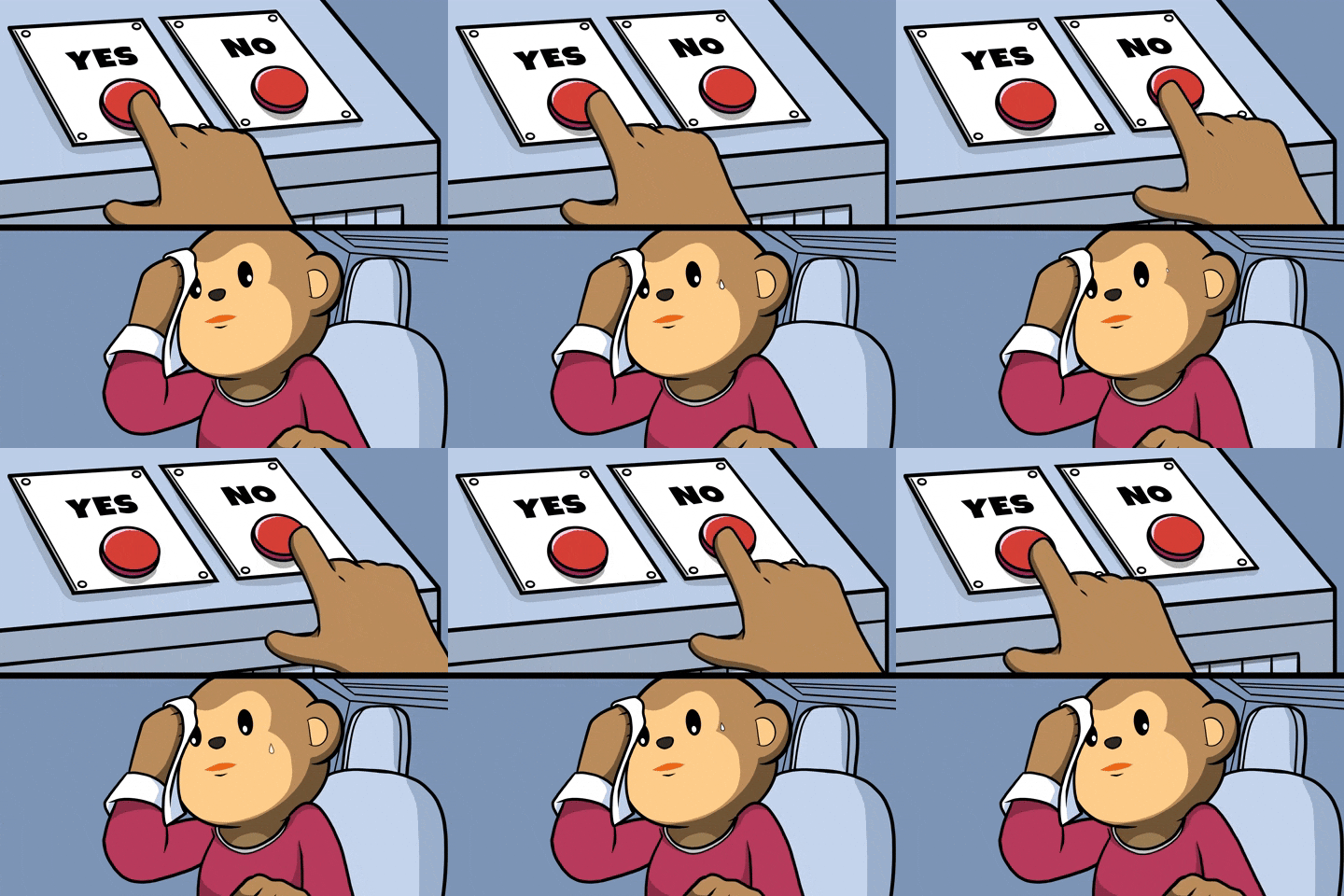
Decision Fatigue: How Small Choices Drain Big Potential
Most people think their productivity breaks down because they don’t have enough time, discipline, or motivation.
But the real killer is something quieter: decision fatigue. I learned this lesson the hard way.
Every day, your brain is forced to make hundreds of choices: what to wear, what to eat, which email to answer first, when to start a project, whether to work out or skip it, etc. None of these choices feels costly in the moment, but behavioral science has made something clear: Every decision has a cognitive price tag, and those tiny tolls add up fast.
Decision fatigue occurs when your mental energy is drained by making constant micro-choices.
As your brain tires, it defaults to the path of least resistance.
You procrastinate.
You avoid tough conversations.
You say yes when you should say no.
You pick easy tasks over meaningful ones.
Not because you’re lazy, but because your brain is overloaded.
High performers don’t solve this by “trying harder.” They solve it by making fewer decisions.
At one point, I was running 6 gyms, 2 eCommerce brands, a hedge fund, an investment portfolio, and trying to be a good father and husband - all at the same time. The problem was, I was trying to make sure I made all the right decisions in every category, every day.
What I learned (from people much smarter than me), is high performers standardize everything that doesn’t need daily input. Morning routines become automatic. Meal choices become predictable. Work blocks become fixed. Workout times become non-negotiable.
These aren’t limitations. They’re liberations. Every decision removed is attention regained.
Automation plays the same role. When you autopay bills, automate savings, schedule recurring tasks, and use presets and templates for anything repetitive, you eliminate the cognitive drag that steals energy from deep work, leadership, creativity, and presence.
Delegation is another multiplier. Any task someone else can do to a competent level gets handed off.
You’re not trying to be a hero. You’re trying to protect your bandwidth.
Over time, something powerful happens. When low-value decisions disappear from your day, clarity rises. Your brain has margin again. You can think strategically instead of reactively. You notice opportunities you used to miss. You handle conflict with more poise. You make smarter bets. You stop burning energy on the trivial and start using it on what actually moves the needle for you and your business.
The real edge in high performance isn’t endless hustle. It’s intentional conservation.
When you remove unnecessary decisions, you don’t just work better.
You lead better, think better, and live better.
Decision fatigue drains momentum. Systemization restores it.
😀 Biggest Story of the Week (Mindset & Psychology)
The Passion vs. Skills Debate Isn’t What It Seems
A new wave of research and commentary is challenging one of America’s most persistent career myths: that young people must choose between passion and practicality.
While the cultural script still pushes the Confucius-style mantra “love what you do,” modern thinkers like Cal Newport argue that passion follows mastery, not the other way around. Surprisingly, the data shows most workers aren’t miserable at all. A 2025 YouGov survey found 74 percent of Americans like or love their jobs, and Pew reports half are highly satisfied.
Why it matters: The real tension isn’t about work itself but about timing. Early careers benefit from skill-building and stability, while passion often grows later, blending into work as expertise and opportunities expand.

Health & Fitness + Longevity

90-Seconds to Reduce Stress
High performers aren’t defined by how much pressure they can absorb. They’re defined by how quickly they can return to a state of clarity once the pressure hits. Read that again.
Modern life traps most people in a constant low-grade stress response, exhibited by a tight chest, racing thoughts, shallow breathing, and a nervous system that never fully resets.
But you don’t need a 20-minute meditation session or a weekend retreat to regain control. You need 90 seconds.
Here’s the key: short, deliberate breathing protocols can immediately downshift the nervous system. Controlled diaphragmatic breathing lowers cortisol, slows the heart rate, and signals your brain that you’re safe enough to think clearly again.
It’s a reset button disguised as a breathing pattern.
The method is straightforward.
Inhale for four seconds.
Hold for four.
Exhale for six.
Pause for two.
Repeat for 10 cycles.
That’s it. No special posture. No quiet room. No equipment. It’s accessible in an office hallway, in your car, while walking into a negotiation, or right before hitting “Join Meeting.” It’s FREE. And it works 100% of the time.
The reason it works is that it interrupts the stress loop at the physiological level. Before your mind has a chance to spiral, your body shifts into parasympathetic dominance.
High performers don’t wait for stress to accumulate before acting. They use micro-resets throughout the day.
This 90-second protocol becomes a tactical pause, a moment to regain composure, sharpen concentration, and step back into the task with intention instead of reactivity. Over time, these reps train the nervous system the same way strength training builds muscle.
Do it consistently, and something deeper changes. Your baseline stress drops. Your resilience rises. The peaks and valleys of your emotional state flatten. You become less thrown off by unexpected challenges and more capable of steady, decisive action. Mental clutter clears faster. Creativity returns quicker. Your nervous system becomes a strategic asset instead of a liability.
To get in the habit of doing this regularly, I put a post it note on my desk that simply says “BREATHE.” I see it all day long, and that helps remind me to stop, slow down, and reset often.
The 90-second breathing reset isn’t a relaxation trick. It’s a performance tool. And I promise you, it’s one of the most underrated tools in the game.
Master it, and you gain the ability to shift from chaos to control on command.
🏋️♀️ Biggest Story of The Week (Health & Fitness)
VO2 Max Emerges as a Leading Predictor of Long-Term Health
A growing body of research is pushing VO2 max into the spotlight as one of the most important indicators of overall health and longevity. Once used primarily by endurance athletes, experts like Peter Attia now argue that VO2 max rivals traditional benchmarks such as bloodwork, BMI, and strength metrics in predicting long-term vitality.
VO2 max measures how much oxygen your body can consume during peak effort. Higher numbers reflect stronger heart and lung function and more efficient muscular oxygen use.
Why it matters: VO2 max strongly predicts everyday functionality. People with low scores can hit 85–90 percent of their capacity just climbing stairs, while those with higher conditioning perform daily tasks at a fraction of their limit. Long-term data reinforces its significance. One landmark study found that even modest increases in VO2 max correlated with a 21 percent reduction in all-cause mortality over 45 years.

Personal Finance Tip of the Week

Mental Accounting: Why You Overspend Without Realizing It
Most people think they overspend because they lack discipline. The truth is far more subtle.
You overspend because your brain is running an outdated operating system.
Humans instinctively sort money into mental buckets, like dining, entertainment, groceries, travel, and bills. Behavioral economists call this mental accounting, and while it feels organized, it often creates invisible distortions.
You convince yourself you’re “good with money” because you stayed under your restaurant budget, even though you quietly overspent your total monthly inflow. You justify a spontaneous purchase because “it’s from my fun money,” ignoring the fact that the same funds could have strengthened savings, reduced debt, or bought back time.
Mental accounting creates the illusion of control while quietly fracturing your financial picture.
High performers approach money differently. They collapse categories so they can see reality clearly.
Instead of dozens of siloed decisions, they run everything through one unified monthly framework: one income pool, one set of priorities, one allocation system. Every dollar serves the mission, not the mood.
The corrective is simple but transformative. Treat every dollar as interchangeable.
Start by identifying your top three financial priorities: savings, investing, and essential living expenses. Automate the first two. That removes emotional decision-making entirely. Then set high-leverage spending limits for categories that matter, like health, family experiences, and education, and strict guardrails for low-value spending.
This is not about austerity. It’s about clarity.
The next step: review your allocations weekly. Not to guilt-trip yourself, but to prevent category drift, the slow financial leak that happens when your micro-decisions don’t match your macro priorities. This weekly audit keeps your behavior tethered to your strategy.
Over time, something powerful shifts. Mental accounting stops being a cognitive trap and becomes a conscious tool. You start making decisions based on impact rather than impulse.
Your savings grow automatically. Your spending becomes intentional. You gain the quiet confidence that your money is aligned with your long-term vision instead of short-term urges.
Wealth building isn’t just about earning more. It’s about seeing clearly, deciding strategically, and removing the invisible frictions that sabotage progress.
Master your mental accounting, and you master your financial trajectory.
💵 Biggest Story of the Week (Personal Finance)
Holding Too Much Cash Could Be Costing You More Than You Think
Cash feels safe, but experts warn that parking too much money in it can silently erode wealth.
Inflation steadily chips away at purchasing power. $10,000 in cash 30 years ago would buy roughly half as much today. Meanwhile, investing that same amount in the S&P 500 would have grown more than eightfold.
Why it matters: While some cash is essential for emergencies or short-term goals, excess liquidity limits long-term growth. Financial planners recommend keeping two to six months of expenses in liquid accounts, then using the rest to invest in diversified assets. Automating investments and sticking to a long-term plan can turn your money into a growth engine rather than letting it sit idle.

Business Playbook

The Invisible Cost of Context Switching
One of the most underestimated productivity killers in modern work is context switching.
On the surface, it seems harmless to jump between an email thread, a Slack message, a spreadsheet, Instagram, and a Zoom call. But cognitive science shows the toll is far steeper than people assume.
Every time you shift attention, your brain must unload one mental model and load another. That reload lag feels minor in the moment, yet across a full day, it compounds into hours of lost clarity and momentum.
Researchers have found that even a brief detour, thirty seconds to glance at a notification, can trigger a multi-minute recovery period before you return to full concentration.
Multiply that across dozens of tiny disruptions, and you’re operating at a fraction of your real capability.
The result is a subtle drag on performance: longer timelines, shallower thinking, and work that feels more exhausting than it should. It’s not the tasks themselves that deplete you; it’s the constant shifting between them.
High performers treat context switching as a structural issue, not a personal failing. They engineer their environment to reduce cognitive friction. They cluster similar tasks together so the mind stays in one operating mode for extended periods. They use deep work blocks, uninterrupted windows where notifications are off, doors are closed, and only one priority exists.
They design communication norms with their teams by designating response windows, meeting-free zones, pre-shared agendas, and clear handoff processes. These systems protect the mental bandwidth required for strategic thinking and creative breakthroughs.
Tools reinforce the behavior. Single-task calendars prevent overlap. Pre-scheduled email and messaging hours eliminate reactive checking. Document-first collaboration ensures teams exchange information without unnecessary meetings.
These aren’t productivity hacks; they’re cognitive safeguards that preserve decision quality and execution speed.
When you control context switching, your work changes shape.
Projects move faster because your attention stays anchored. Complex problems become more approachable because your mind has the space to explore deeply instead of skimming. Energy lasts longer across the day because you’re no longer burning it on constant reorientation.
The payoff is transformative: smoother execution, sharper insights, and the ability to scale high-value work without burning out.
By eliminating the hidden tax of context switching, you reclaim hours of meaningful output that were slipping away unnoticed.
📚 Biggest Story of the Week (Business)
Skipping the MBA: Why Building Beats Classroom Learning
For decades, the two-year MBA has been the gateway to finance, tech, and consulting careers. But tech billionaire Joe Liemandt argues real-world experience trumps classroom theory.
The Trilogy Software and ESW Capital founder says nothing an MBA teaches compares to actually building a business.
Why it matters: MBA programs teach frameworks and spreadsheets, but entrepreneurs learn by doing, adapting, and solving problems in real time. Liemandt emphasizes that while MBAs analyze obstacles, entrepreneurs figure out how to overcome them.
Top business leaders, including Jobs, Gates, Dell, and Zuckerberg, succeeded without an MBA. For those willing to take risks, jump-starting a venture can provide more practical lessons, faster growth, and a chance to “change reality” rather than just study it.

DOPAMINE HIT

Thanks for reading!
If you enjoyed this week’s newsletter, please share it with some friends! And thank you for reading!
🗓️ STAY TUNED:
Next week, we’ll dive into the science of “micro-goals” and how tiny, incremental progress compounds into massive personal and professional wins.
… Stay tuned. You won’t want to miss it!
Here’s to your success,

Austin L. Wright

Join my inner circle - Follow me on X for daily business breakdowns, lifestyle hacks, and a behind-the-scenes look at what my team and I are building.
Follow me on IG to see how I’m living the blueprint. I practice what I preach.
P.S.
We’re always looking to improve and create better newsletters for you in the future. If you have any feedback or suggestions for future editions, I’d love to hear from you! Just reply directly to this email and give me some ideas for how you think we could make it better!
If you’re reading this online, make sure you subscribe using the button below:
Disclaimer: The ideas shared in this newsletter are those of the author, and this is in no way intended to be medical, legal, or financial advice. Always do your own research and consult with licensed professionals.
Reply